
The family of Harish Rana, the first person in India permitted passive euthanasia, bid him farewell at his cremation in Delhi. Rana's organs were donated, and mourners gathered to pay their respects after a 13-year ordeal following a tragic accident.
The family of Harish Rana, who was granted permission for passive euthanasia by the Supreme Court, immersed his ashes in the Ganga River, marking the end of a 13-year ordeal following a tragic accident.

The family of Harish Rana, India's first passive euthanasia patient, bid him farewell at his cremation in Delhi. Rana's death follows a Supreme Court ruling allowing the withdrawal of life support.

The Supreme Court of India has allowed passive euthanasia for a 32-year-old man who has been in a permanent vegetative state since 2013, highlighting the legal and ethical considerations surrounding the right to die with dignity.
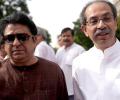
'Raj Thackeray is working at the behest of Chief Minister Devendra Fadnavis.'

Is it is necessary to play divisive politics to succeed in the next general elections? asks Dr Sudhir Bisht.

The Ashokan Pillar in Kolhua, Bihar, is one of India's best maintained historical sites.
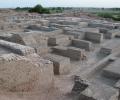
'They were certainly not practising Hinduism in the Harappan culture (which includes Mohenjo Daro and other sites).' 'There was no notion of Hinduism then.'

Prince Victor Albert Jay Duleep Singh's mansion is located in one of south-west Kensington's most sought after residential addresses.

None of them had anything to do with the violence at Bhima Koregaon, where they were not even present, points out Aakar Patel.

'Does a thousand-year-old sculpture worshipped in a thriving religion belong to a foreign museum or the temple from which it was extracted?' Congress MP Shashi Tharoor asked angrily. 'They legitimately belonged to India and people of past, present and future generations are interested in re-possessing them,' a central information commissioner declared last month.

Why do the biggest, most talented and successful film-makers of India suck up to the establishment so breathlessly, asks Shekhar Gupta.

His songs were the anchor, the substratum, if you will, upon which life unfolded day after day, decade after decade -- across villages, towns, cities, and regions. Siva Sankar pays tribute to S P Balasubrahmanyam, the legendary singer who passed into the ages on Friday.

'What Trump and Kim have demonstrated is that leaders need not remain prisoners of the status quo and they can, by showing the necessary will and courage, break out of the hang-ups and constrictions of the past and carve out a new pathway for themselves,' says B S Raghavan.

'... A youth movement which could really transform our politics in a way that the existing elites don't understand.' 'The more you suppress free expression, the more people will value it.' 'The State can't suppress a young society like India where there are so many interesting new ideas emerging,' says Sunil Khilnani, whose latest book Incarnations looks at Indian history through 50 lives.

Unless the judges factor in the ungovernability of technologies and their beneficial owners, present and future Presidents, prime ministers, judges, legislators and officials handling sensitive assignments may become redundant with reference to their age-old roles for securing 'national resources and assets', warns Dr Gopal Krishna.

'Over one million people served in various battlefronts during World War I. And yet, even today, we know so very little about them.' 'It is absolutely essential to acknowledge this part of India's colonial history,' Santanu Das tells Vaihayasi Pande Daniel/Rediff.com

MUST READ: The speech Nayantara Sahgal was not allowed to give.
